Results
This page presents Open-TYNDP assumptions and outcomes for the Scenario Building (SB) of the National Trends (NT) scenario, climate year 2009. The input data covers reference grids, final energy demand, capacity factors and installed capacities, all aligned to TYNDP 2024 inputs and assumptions. The model then produces optimised supply, transmission, and marginal prices for both electricity and hydrogen — explore them interactively below.
Open-TYNDP outcomes are benchmarked with ENTSO-E reference data. Aggregated EU27 comparisons are shown on this page; per-country and per bidding zone results, including marginal prices, cross-border flows, generation, and installed capacities, are available for download from Open Energy Transition's Zenodo repository. For this proof of concept, the primary benchmark comparison is between Open-TYNDP and the Market Model output files. The final Scenarios Report figures provide additional context, but are the result of further data processing and aggregation steps applied to the Market Model outputs. This introduces differences between the Market Model data and the Scenarios Report.
Scenario Building
Input data
The following publicly available datasets are used as input to Open-TYNDP and as benchmarking references throughout this page:
- TYNDP 2024 reference grid input data — Network topology and transfer capacities
- TYNDP 2024 final Scenarios Report — Published scenario assumptions and results
- Market Model output files (NT 2030 and NT 2040) — Market model outputs used as the primary benchmarking reference
The Market Model output files also contain fixed input assumptions, including exogenous demand and reference grid data, which are used as a complement to the publicly available input data.
For the purposes of this proof of concept, the primary benchmark comparison is made between the Market Model output files and Open-TYNDP.
Reference grids
The interactive map shows the reference grid for 2030 and 2040 for both electricity and hydrogen. Use the toggle below to switch between the two energy carriers and the two planning horizons.
For electricity, the map displays a network topology based on bidding zones, where each node represents an electricity market area with its own generation mix, demand, and cross-border interconnections. Connections between zones reflect Net Transfer Capacities (NTC), the maximum power that can flow between neighbouring market areas. The installed generation capacity per node is shown directly on the map as pie charts, and the fixed electricity demand is shown in the hover tooltip for each area. The hydrogen network follows the same logic but at country resolution: each node has its own mix of supply sources, demand, and pipeline connections to neighbouring countries, with installed hydrogen supply capacity shown per node as pie charts. The Offshore Hubs dataset defines the nomenclature of offshore nodes, as well as the generation and transmission capacities. Offshore wind farms are either radially connected or connected via these interconnectors.
The demand shown for both carriers reflects only the fixed, exogenous input demand and does not include, for example, additional electricity consumption from electrolysis, which is determined by the optimisation.
In addition to using the reference grid input data, Open-TYNDP derives maximum transfer capacities from the observed flows in the Market Model output files for ensuring a consistent assumption versioning. This applies strictly to exogenous input variables that are fixed prior to optimisation and must not change as part of it. No adjustment is made to any variable that is part of the optimisation itself. The deviations are likely due to versioning changes during the modelling and stakeholder process.
Note: Capacities are shown per direction as NTC.
Installed capacities
The chart shows installed capacities aggregated at EU27 level, comparing Open-TYNDP against the Market Model output files and the final Scenarios Report. In general, Open-TYNDP installed capacities are aligned with the PEMMDB dataset. Per-country comparison plots are available on Zenodo.
For renewable capacities, Open-TYNDP and the Market Model outputs show lower values than the Scenarios Report, because the Scenarios Report includes off-grid renewable capacities, installations not connected to the transmission network, which are not part of the modelled system. Solar thermal is not yet included in Open-TYNDP; its contribution to overall generation is small (0.3–0.5% of total generation according to the Market Model output). Conventional power plants running on biofuel are not separately listed but included within conventional capacities.
Note: Demand Side Response (DSR) values in the Scenarios Report include implicit DSR (iDSR), whereas Open-TYNDP and Market Model values reflect explicit DSR only. Additionally, the Scenarios Report includes off-grid renewable capacities, which are not part of the modelled system. Solar thermal is not yet included in Open-TYNDP.
Final energy demands
The chart shows final energy demand aggregated at EU27 level across all sectors, including the energy sector, non-energy use, international aviation and international shipping. Final energy demand for electricity matches closely between Open-TYNDP and the Market Model output while the Scenarios Report excludes losses. The Market Model does not include demand for liquids, biofuels, and methane. These carriers are part of the broader energy system modelled in Open-TYNDP but fall outside the scope of the Market Model. The Scenarios Report shows final energy demand, while the Supply Tool, which was used as input for Open-TYNDP, includes non-final uses. Therefore, Open-TYNDP values are strictly higher for liquids, biofuels, and methane.
For hydrogen demand, the publicly available input data showed deviations from the assumptions visible in the final Scenarios Report and Market Model output. These can arise from the complexity of the data, differences in how it is reported (e.g. geographical scope, time resolution, final vs. total demand), and revisions throughout the whole modelling and stakeholder process. To align with the TYNDP 2024 final report, Open-TYNDP uses the hydrogen demand assumptions from the Market Model output for ensuring a consistent assumption versioning. The Scenarios Report shows final energy demand, while the Market Model and Open-TYNDP include the exogenous demand for hydrogen used to produce synthetic fuels. For methane demand, gas demand figures are derived from the Supply Tool for EU27 countries. Non-EU27 countries are currently missing from the methane demand data, as no suitable data source has been identified for them.
Note: The Market Model does not include liquids, biofuels, and methane energy demand, as these fall outside its scope. In contrast to the Scenarios Report and similar to the Supply Tool, Open-TYNDP incorporates non-final uses within energy demand, resulting in strictly higher values.
Power supply
The map gives a pan-European view of the optimised electricity system for the National Trends scenario. Each circle shows generation (upper half) and consumption (lower half) per node, with arrows indicating net annual cross-border flows and background colours reflecting marginal electricity prices. All variables are outcomes of the Open-TYNDP optimisation. Hover over individual nodes to explore the mix in detail.
Note: Flows represent net annual values per direction.
Electricity generation — Open-TYNDP vs. Market Model output vs. Scenarios Report
Overall, Open-TYNDP generation closely matches the TYNDP 2024 reference outputs. The following differences are traceable to specific modelling choices or data availability constraints. Per-country comparison plots are available on Zenodo.
Open-TYNDP shows a higher share of nuclear generation compared to the Market Model output. This is because maintenance and outage schedules for nuclear plants were internal Market Model assumptions that were not publicly available in TYNDP 2024 (further details in the corresponding Pull Request). The higher nuclear share results in a lower share of methane generation. Hydrogen-to-power generation is lower in Open-TYNDP, especially in 2040, likely reflecting a methodological difference: in Open-TYNDP, hydrogen power plants are directly connected to the hydrogen market and the fuel price is determined endogenously, whereas the Market Model assumes a fixed hydrogen fuel price. The capacity factors for renewable generation derived from the publicly available PECD dataset also differ from those used internally in the Market Model, leading to slight deviations in renewable generation even where installed capacities are the same. Overall electricity generation in Open-TYNDP is also slightly lower than in the Market Model, as Open-TYNDP currently does not model countries, and their exchanges, not included in the input list of nodes. Finally, solar thermal is not yet included in Open-TYNDP, though its contribution to overall generation is small (0.3% in 2030 and 0.5% in 2040 according to the Market Model output).
Note: The Scenarios Report includes Other Non-RES generation aggregated together with conventional power plants; and off-grid renewable generation, which are not part of the modelled system. In Open-TYNDP, hydrogen power plants are directly connected to the hydrogen market. The Market Model assumes a fixed hydrogen fuel price. Finally, renewables generation values reflect available energy prior to curtailment.
Power generation time series
Note: You can change the time scale of interactive time-series plots by clicking and dragging horizontally.
Hydrogen supply
The map gives a pan-European view of the optimised hydrogen system. Hydrogen can be produced via electrolysis (green), steam methane reforming (SMR) (grey), steam methane reforming with carbon capture and storage (SMR with CCS) (blue), or imported. The mix at each node is determined by the optimisation. Each circle shows hydrogen supply (upper half) and consumption (lower half) per node, with arrows indicating net annual cross-border flows and background colours reflecting marginal hydrogen prices. Consumption includes both exogenous hydrogen demand from the TYNDP and endogenous use for hydrogen-to-power, optimised jointly with the electricity system.
In the standard PyPSA-Eur framework, hydrogen demands are not given exogenously but compete with other energy carriers to meet transport or industry demand. In Open-TYNDP, this has been adapted to align more closely with TYNDP 2024 assumptions, but could in the future be reverted to make use of the full sector-coupled capabilities (further details in the Open-TYNDP innovation roadmap).
Note: Flows represent net annual values per direction.
Hydrogen supply — Open-TYNDP vs. Market Model output vs. Scenarios Report
Overall, Open-TYNDP hydrogen supply outcomes are broadly comparable to the TYNDP 2024 reference outputs. A few methodological differences lead to some deviations. Per-country comparison plots are available on Zenodo.
Unlike the Market Model and the Scenarios Report, which assume a fixed hydrogen fuel price for hydrogen-to-power generation, Open-TYNDP couples electricity and hydrogen markets by using an endogenous hydrogen fuel price. Because the price is fixed in the Market Model and the Scenarios Report, the supply of hydrogen required for hydrogen-to-power is reported as "Undefined for generation", meaning the source (import or domestic) is not distinguished. In Open-TYNDP, this share is explicitly modelled and is therefore included as either imported or sourced domestically. For both Open-TYNDP and the Market Model, nodes are exclusively defined with grey or blue hydrogen assets. This differs from the standard PyPSA-Eur modelling approach, in which their shares are optimised endogenously. However, the Market Model reports hydrogen supply aggregated as SMR only. Open-TYNDP also explicitly models CO₂ emissions (atmospheric release and geological storage), with CO₂ transmission and sequestration depending on geographical storage potentials and reuse options, following the full sector-coupled approach of the underlying PyPSA-Eur framework.
These methodological differences have direct consequences for the supply outcomes: Open-TYNDP shows a smaller share of domestic hydrogen production and a larger share of imports compared to the Market Model. The share of electrolysis and green hydrogen is also lower in Open-TYNDP, particularly in 2040, reflecting the endogenous cost optimisation of production pathways. Finally, the remaining gap between the Market Model and the Scenarios Report corresponds to off-grid hydrogen production.
Note: Open-TYNDP uses endogenous hydrogen fuel prices. The price is fixed in the Market Model and the Scenarios Report and the supply of hydrogen is reported as "Undefined for generation". In Open-TYNDP, however, this share is "defined" as either imports or domestic production.
Hydrogen time series
Note: You can change the time scale of interactive time-series plots by clicking and dragging horizontally.
Performance
The table below reports the computational performance of the Open-TYNDP SB workflow, measured as total solving time and peak memory usage per planning horizon.
| Component | Planning horizon | Solving time (s) | Peak memory (GB) |
|---|---|---|---|
| SB | 2030 | 897 | 29.3 |
| SB | 2040 | 2559 | 29.6 |
Cost-Benefit Analysis
This section presents Open-TYNDP assumptions and outcomes for the Cost-Benefit Analysis (CBA) of individual transmission and storage projects submitted for the TYNDP, evaluated against a common reference grid. Open-TYNDP currently implements the CBA as a market model, which means only the system-level indicators B1–B4 can be calculated at this stage.
Input data
Project-level data used for the CBA, including project identifiers, connecting nodes, capacities, and cost estimates, is sourced from the ENTSO-E TYNDP projects map.
Indicators B1–B4
Open-TYNDP computes the system-level cost-benefit indicators B1–B4 for each project, quantifying its impact on total system costs, RES integration, and other system benefits. The chart below benchmarks these indicators across all transmission and storage projects against the official TYNDP 2024 reference values.
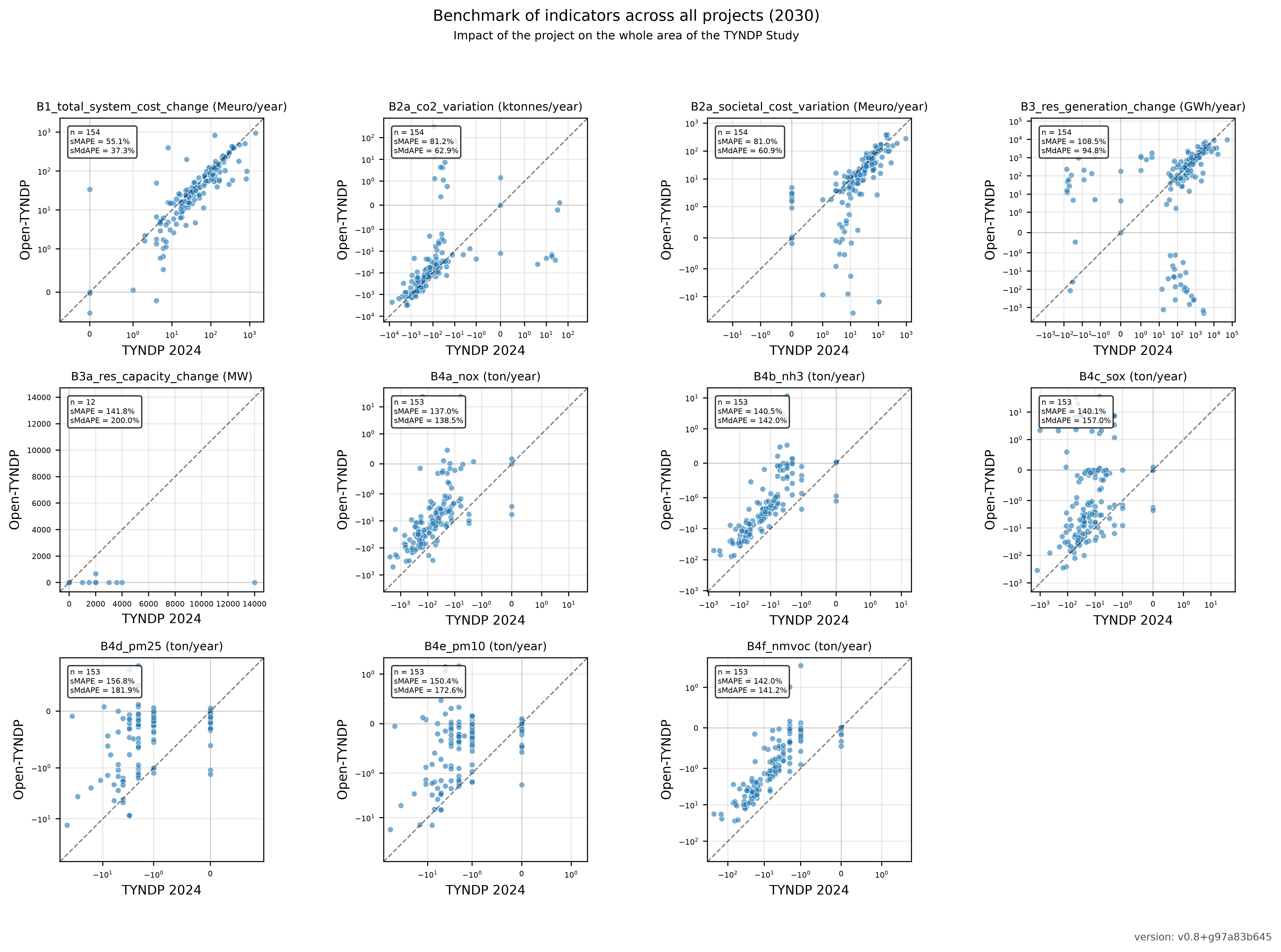
Note: sMAPE and sMdAPE report the symmetric mean and median absolute percentage error between Open-TYNDP and TYNDP 2024 across all transmission projects (n).
Several factors contribute to the deviation between Open-TYNDP and the official TYNDP 2024 results shown above:
- The official TYNDP 2024 results are themselves an average across five different models, with outliers removed, rather than the output of a single model.
- Open-TYNDP does not yet model additional renewable generation capacity unlocked by a project. This affects 12 of the 126 transmission projects, where the official TYNDP 2024 results add renewable capacity as part of the project's impact, visible directly in indicator B3a, where Open-TYNDP shows no additional capacity while the official results show up to 14 GW. For these 12 projects, deviations naturally carry over into the other indicators as well.
- Open-TYNDP is a fully sector-coupled model with endogenous fuel prices, whereas the official TYNDP 2024 National Trends scenario assumes fixed prices for fuels, e.g. for hydrogen-fuelled power plants.
- The rolling horizon implementation, and particularly the treatment of long-term storage behavior, may differ between models; no public documentation describes exactly how this is handled in the official TYNDP process. Open-TYNDP applies marginal storage (water) values from a full-year optimization to approximate long-term storage behavior within the weekly-foresight rolling horizon.
- The modifications applied when moving from the SB to the CBA are not fully documented publicly, so some deviations, for example in the reference grid, may result in different results for the indicators.
- Numerical stability in the CBA: lower costs of load shedding improve stability. But projects with very small cost benefits, can result in negative B1 indicators. Since a transmission project should not increase operational costs, a negative B1 indicator reflects this numerical instability rather than a genuine negative benefit and thus should be interpreted as approximately zero.
Performance
Running the CBA across the full set of candidate projects is computationally demanding. The Open-TYNDP CBA workflow is nevertheless quite performant: the table below reports the solving time and peak memory usage observed for the Marginal Storage Values (MSV) and Rolling Horizon reference (RH ref) runs, per planning horizon.
| Workflow | Planning horizon | Solving time (s) | Peak memory (GB) |
|---|---|---|---|
| MSV | 2030 | 619 | 30.7 |
| MSV | 2040 | 769 | 30.7 |
| RH ref | 2030 | 915 | 5.8 |
| RH ref | 2040 | 1306 | 5.8 |
Limitations
- The CBA workflow is still under active development.
- Currently, only a market model is implemented.
- Additional renewable generation capacities unlocked by a project is not yet modelled.